
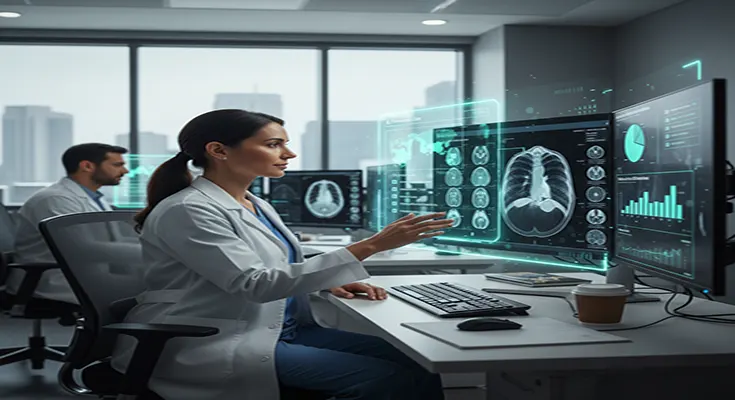
In 2025, the global healthcare system faces a daunting paradox: medical imaging volumes are at an all-time high, yet the number of practicing radiologists is struggling to keep pace. This “imaging gap” has transformed Artificial Intelligence (AI) from a futuristic luxury into an operational necessity. Rather than replacing the specialist, the benefits of artificial intelligence in improving radiology workflow efficiency center on removing the “administrative friction” that historically bogged down diagnostic speed.
1. Intelligent Triage and Worklist Prioritization
Traditionally, radiologists reviewed scans on a “first-in, first-out” basis. In an emergency setting, this could mean a life-threatening brain hemorrhage might sit in a queue behind a routine ankle X-ray.
Modern AI algorithms now perform automated triage. As soon as a scan is completed, AI “pre-reads” the pixels in seconds. If it detects a critical finding—such as a stroke, pulmonary embolism, or tension pneumothorax—it automatically moves that case to the top of the radiologist’s worklist and triggers an immediate alert. This ensures that time-sensitive cases receive the fastest intervention, directly improving patient survival rates.
2. Automating the “Labor of Measurement”
A significant portion of a radiologist’s shift is spent on repetitive, manual tasks: measuring the diameter of a lung nodule, calculating the volume of a heart chamber, or tracking the growth of a tumor over multiple years.
AI excels at these quantitative tasks. Computer vision tools can now segment organs and lesions with sub-millimeter precision in a fraction of the time a human would require.
- Efficiency Gain: By automating these measurements, AI can reduce the time spent on complex cases (like oncology follow-ups) by up to 25-40%, allowing the radiologist to focus on the nuanced interpretation of the data rather than the manual data entry.
3. AI-Powered Report Generation
The final bottleneck in the radiology workflow is documentation. In 2025, Generative AI has revolutionized the reporting process. Instead of a radiologist dictating every word from scratch, “Foundation Models” now generate preliminary draft reports based on the AI’s findings.
The radiologist then acts as an editor rather than an author. These systems can:
- Auto-populate “normal” findings.
- Compare current findings with historical reports to highlight changes.
- Standardize terminology, ensuring the referring physician receives a clear, structured, and actionable report faster.
4. Enhancing Image Quality at the Source
Efficiency also improves during image acquisition. AI algorithms embedded within MRI and CT scanners can now “clean” images in real-time, removing artifacts caused by patient movement or low-dose radiation.
- The Result: Fewer “retakes” are needed. When a patient doesn’t have to be brought back for a repeat scan due to poor image quality, the entire department’s throughput increases, and patient radiation exposure is minimized.