Dubai stands as a global hub for commerce, attracting entrepreneurs and businesses with its dynamic economy, strategic location, and pro-business environment. Setting up a business in Dubai involves a series of structured steps designed to ensure regulatory compliance and facilitate smooth operations. This article outlines the essential stages involved in a business set up in Dubai, providing clarity on the requirements and processes from initial planning to operational readiness.
Overview
- Understanding Jurisdictions: The initial step involves choosing between Mainland, Free Zone, or Offshore, each with distinct advantages and regulations.
- Defining Business Activities: Clearly identifying the scope of operations is crucial for licensing and approvals.
- Legal Structure Selection: Determining the appropriate legal entity (e.g., LLC, sole proprietorship, branch office) based on ownership and liability.
- Trade Name Reservation: Securing a unique and compliant name for the business.
- Licensing and Approvals: Obtaining necessary permits from relevant government authorities.
- Office Space and Visas: Arranging physical or virtual office solutions and processing residency visas for owners and employees.
- Corporate Bank Account: Establishing a local bank account for financial transactions.
- Ongoing Compliance: Adhering to local laws, tax regulations, and renewal processes.
What are the initial steps for a business set up in Dubai?
Starting a business set up in Dubai requires foundational decisions that impact the entire process. These initial steps establish the framework for your future operations.
- Determine Your Business Activities: Before anything else, clearly define the exact nature of your business operations. Dubai’s Department of Economy and Tourism (DET) and various Free Zones list thousands of permissible activities, and your chosen activities will dictate your license type and requirements.
- Select the Appropriate Legal Structure: Your business structure depends on ownership, liability, and operational goals. Common structures include:
- Limited Liability Company (LLC): Popular for mainland operations, typically requires a local sponsor (UAE national) owning 51% for most activities, though 100% foreign ownership is now allowed for many sectors.
- Sole Proprietorship: Owned by a single individual, offering full control but unlimited liability.
- Branch Office/Representative Office: For foreign companies wishing to establish a presence without forming a new legal entity.
- Free Zone Company: Offers 100% foreign ownership, full repatriation of capital and profits, and often specific sector focus.
- Offshore Company: Used for international trading and asset protection, not permitted to conduct business within the UAE.
- Choose Your Jurisdiction: Decide whether to set up in Dubai Mainland or one of its numerous Free Zones.
- Mainland: Governed by the DET, allows direct engagement with the local market and government projects.
- Free Zones: Independent economic zones offering specific incentives, ideal for businesses focused on international trade or specific industries.
- Reserve Your Trade Name: Select a unique trade name that complies with UAE naming conventions. The name must not contain offensive language, religious terms, or refer to governmental bodies. It must also be followed by the legal structure abbreviation (e.g., LLC, FZCO).
Why choose Dubai for your business set up?
Dubai offers a compelling environment for entrepreneurs and investors, making it a preferred location for business set up in Dubai.
- Strategic Global Location: Positioned at the crossroads of East and West, Dubai provides unparalleled access to markets in Africa, Asia, and Europe.
- Tax Efficiency: Businesses often benefit from zero corporate and personal income tax, making it highly attractive for profit retention.
- Stable Economy and Government: The UAE boasts a robust and diversified economy, supported by a stable political environment and clear regulatory frameworks.
- World-Class Infrastructure: Modern facilities, including state-of-the-art airports, seaports, roads, and telecommunications, support efficient business operations.
- Ease of Doing Business: The government has made significant efforts to streamline processes, reduce bureaucracy, and offer incentives to attract foreign direct investment.
- Skilled Workforce and Talent Pool: A multicultural environment attracts a diverse and skilled workforce from around the globe.
- Investor-Friendly Policies: Policies like 100% foreign ownership in many sectors and Free Zone benefits further enhance its appeal.
Who can establish a business in Dubai?
Dubai’s welcoming business environment caters to a broad spectrum of individuals and entities seeking business set up in Dubai.
- Individual Entrepreneurs: Local and expatriate individuals with innovative ideas and business plans are encouraged to start sole proprietorships or small businesses.
- Small and Medium-sized Enterprises (SMEs): Both local and international SMEs find Dubai an ideal launchpad due to accessible Free Zone options and supportive business ecosystems.
- Large Corporations: Multinational companies often establish regional headquarters, branches, or subsidiaries to tap into the MENA market.
- Foreign Investors: Investors from around the world are eligible to set up businesses, benefiting from liberal foreign ownership laws and attractive investment policies.
- Startups: The emirate has a growing startup ecosystem, with incubators, accelerators, and funding opportunities supporting new ventures.
When is the opportune time for business set up in Dubai?
The dynamic nature of Dubai’s economy means there isn’t a single “best time” for business set up in Dubai; rather, readiness and market insight are key.
- Any Time is Generally Suitable: Dubai’s economy is resilient and constantly evolving, making it generally favorable for new ventures throughout the year. The government consistently introduces initiatives to support business growth.
- After Thorough Market Research: The opportune time is when you have completed detailed market research, identified a clear demand for your product or service, and developed a robust business plan.
- During Economic Growth Phases: While Dubai’s growth is consistent, aligning your launch with specific sectoral growth trends or major events (like Expo periods) can provide an initial boost.
- When Capital is Secured: Ensuring you have adequate funding for initial setup, operational costs, and working capital is a primary factor in determining your readiness.
- With Clear Regulatory Understanding: Once you have a firm grasp of the legal and regulatory framework applicable to your chosen business activity and jurisdiction.
Where are the locations for business set up in Dubai?
The “where” of business set up in Dubai primarily revolves around selecting the appropriate jurisdiction, each offering distinct operational scopes and benefits.
- Dubai Mainland: This jurisdiction allows businesses to operate directly within Dubai’s local market, engage in government tenders, and trade freely across the UAE. Licensing is primarily handled by the Department of Economy and Tourism (DET). Mainland companies often have more options for physical office locations across the emirate.
- Dubai Free Zones: There are over 40 specialized Free Zones in Dubai, each designed to foster specific industries and offer unique incentives.
- Advantages of Free Zones: 100% foreign ownership, 100% repatriation of capital and profits, customs duty exemptions, simplified setup procedures, and a robust regulatory environment.
- Examples: Dubai Multi Commodities Centre (DMCC) for commodities and trading, Dubai Internet City for technology, Dubai Media City for media, and Meydan Free Zone for a wide range of activities including trading, services, and consulting, offering cost-effective and efficient solutions.
- Dubai Offshore: Offshore companies are legal entities incorporated in Dubai but primarily conduct business outside the UAE. They are typically used for international trading, holding assets, and inheritance planning, offering privacy and tax efficiency without a physical presence in the UAE.
How to execute the business set up process in Dubai?
Executing the business set up in Dubai involves a systematic approach, moving from initial approvals to obtaining your operational license.
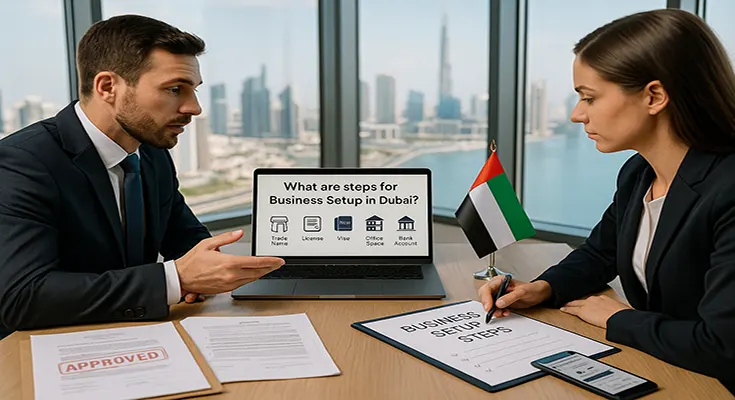
- Step 1: Choose Your Business Activity, Legal Structure, and Jurisdiction. As discussed, this foundational decision determines subsequent steps. For instance, a services company looking for 100% foreign ownership might opt for a Free Zone.
- Step 2: Reserve Your Trade Name. Submit your preferred business names to the relevant authority (DET for Mainland, Free Zone Authority for Free Zone) for approval and reservation.
- Step 3: Secure Initial Approval. Obtain an initial approval certificate from the licensing authority, confirming that there are no objections to your proposed business activities and trade name.
- Step 4: Prepare Memorandum of Association (MOA) and Local Service Agent (LSA) Agreement (if applicable). For Mainland LLCs, an MOA outlining shareholder agreements is needed. If 100% foreign ownership is not permitted for your chosen activity, an LSA agreement with a UAE national might be required for specific professional activities.
- Step 5: Find a Physical Office or Business Address. Depending on your chosen jurisdiction and legal structure, you will need a registered office address. Free Zones often offer flexible office solutions, including flexi-desks, dedicated offices, or virtual office packages.
- Step 6: Submit Required Documents and Pay Fees. Compile all necessary documents (passport copies, visa details, NOCs, MOA, tenancy contract) and submit them to the licensing authority. Pay the required government fees for your license, initial approvals, and registration.
- Step 7: Obtain Your Business License. Upon successful submission and payment, the authority will issue your official business license. This is your legal permit to operate.
- Step 8: Open a Corporate Bank Account. With your license in hand, you can proceed to open a corporate bank account with a local bank. This step often requires extensive due diligence from the bank.
- Step 9: Process Residency Visas. If you are an expatriate owner or wish to sponsor employees, the final step involves applying for investor or employment visas, Emirates IDs, and health insurance.
Meydan Free Zone can streamline this entire process by offering comprehensive packages that include license registration, office solutions, and assistance with visa processing, ensuring a smooth and efficient business set up in Dubai. Their team of experts guides applicants through each requirement, simplifying the journey for entrepreneurs and established businesses alike.