


Cost of Implementing Custom Artificial Intelligence Solutions for Enterprise Businesses

Cost of Implementing Custom Artificial Intelligence Solutions for Enterprise Businesses

Many corporate leadership teams fall into the trap of viewing artificial intelligence through the lens of consumer subscription pricing. They contrast the illusion of “cheap” off-the-shelf APIs with the complex financial reality of building, training, and maintaining a custom enterprise-grade AI solution.

As organizations move beyond generic chatbots toward proprietary, domain-specific models, they realize that custom AI requires a major capital commitment. Accurately budgeting for custom enterprise AI requires looking far beyond initial development costs to encompass compute infrastructure, data engineering, ongoing maintenance, and long-term risk management.

Capital Expenditure (CapEx) vs. Operating Expenditure (OpEx)

Building a proprietary AI solution from the ground up demands a careful evaluation of initial financial outlays across hardware, data, and human capital:

  • Compute and Infrastructure Investments: Training or fine-tuning advanced models requires staggering amounts of computational power. Enterprises must budget for high-performance GPUs (such as NVIDIA H100s or next-generation accelerators), dedicated cloud clusters across AWS,
… Cost of Implementing Custom Artificial Intelligence Solutions for Enterprise Businesses Read More
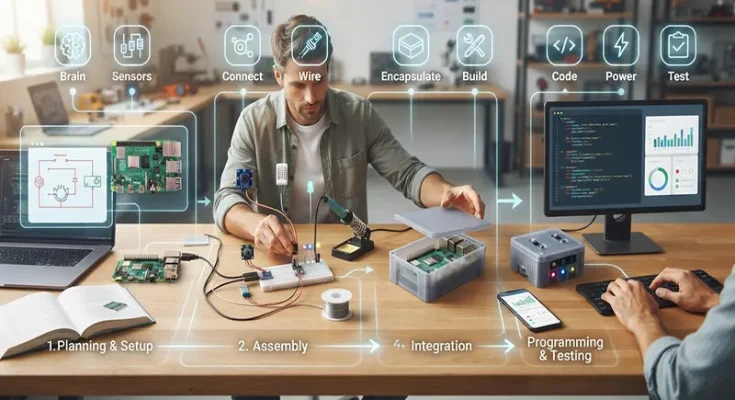
Step-by-Step Guide to Build a Custom IoT Object with Raspberry Pi

Step-by-Step Guide to Build a Custom IoT Object with Raspberry Pi

Off-the-shelf smart home gadgets are convenient, but they are often restricted by closed ecosystems, proprietary apps, and rigid feature sets. For developers and makers who want total control over their hardware, building a custom connected device is the ultimate solution.

The Raspberry Pi ecosystem empowers engineers to prototype industrial-grade smart objects quickly and affordably. By combining low-cost sensors, Python programming, and lightweight messaging protocols, you can transform a single-board computer into a fully functional, cloud-connected IoT monitoring node.

Hardware Bill of Materials and Architecture

Before writing a single line of code, you need to assemble the physical building blocks of your IoT node:

  • Core Processor: The Raspberry Pi Zero 2 W or Raspberry Pi 4/5 serves as the brain of the project, providing built-in Wi-Fi and Bluetooth connectivity for remote data transmission.
  • Sensors and Actuators: For this build, we will use a DHT22 temperature and humidity sensor, an RGB
… Step-by-Step Guide to Build a Custom IoT Object with Raspberry Pi Read More