
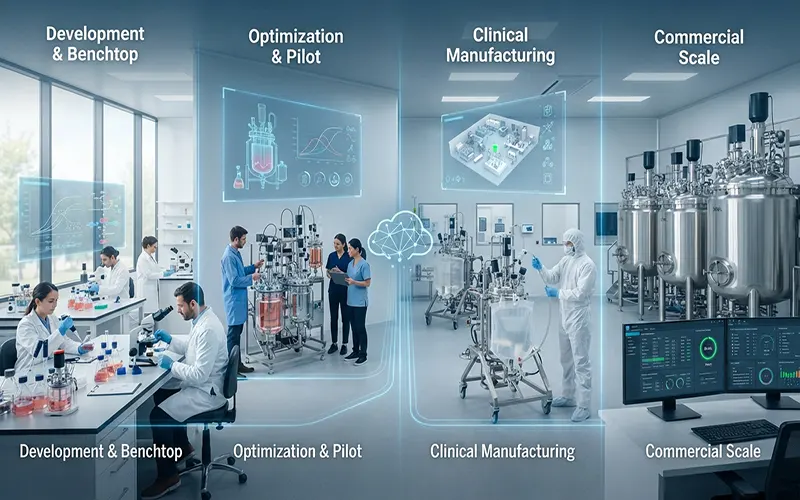
For years, the cell and gene therapy (CGT) sector was defined by bespoke, small-batch, manual benchtop production. These labor-intensive methods were necessary to prove clinical efficacy in early-stage trials, but they are entirely unsustainable for commercial delivery.
Today, the industry faces a pressing modern mandate: industrialize and scale. As these advanced genetic medicines transition from experimental breakthroughs to standard-of-care treatments, the primary industry bottleneck has shifted from scientific discovery to reproducible, cost-effective manufacturing. Successfully scaling CGT biomanufacturing requires transitioning from open manual operations to standardized, automated, closed-system processing and robust vector optimization to ensure long-term commercial viability.
Overcoming Bottlenecks in Viral Vector Production
Viral vectors—such as adeno-associated viruses (AAV) and lentiviruses—are the critical delivery vehicles for genetic therapies, yet their production remains notoriously difficult to scale:
- Scaling Plasmid and Viral Vector Yields: Traditional transient transfection protocols struggle with batch-to-batch variability and high reagent costs. The industry is rapidly shifting toward stable producer cell lines and high-density suspension bioreactors to maximize volumetric yields and ensure consistency.
- Downstream Purification Challenges: Harvesting pure viral vectors requires navigating complex downstream bottlenecks, including tangential flow filtration (TFF) and advanced chromatography designed to remove host-cell proteins, empty capsids, and DNA impurities without damaging fragile viral particles.
- Quality and Potency Assay Integration: Traditional bioassays can take weeks to return results, creating massive inventory holding bottlenecks. Implementing rapid, real-time analytical testing for vector genome titers and infectious units is vital for modern process control.
Transitioning from Manual Protocols to Automated, Closed Systems
Manufacturing living cells requires an entirely different engineering mindset compared to traditional small-molecule drugs or even monoclonal antibodies:
- The Risk of Open Processing: Manual, open-vessel cell handling introduces significant contamination risks, heavy reliance on highly trained human operators, and unacceptably high batch failure rates.
- Adopting Integrated Closed Platforms: Modern facilities are implementing fully automated bioreactors, robotic cell expansion units, and sterile tube-welding technologies. These systems maintain a sterile barrier from initial cell isolation to final fill-and-finish.
- Digital Twins and Process Analytical Technology (PAT): Utilizing real-time sensors, multivariate data analysis, and AI-driven predictive models allows engineers to monitor pH, dissolved oxygen, and metabolite fluxes dynamically, adjusting parameters before deviations impact cell viability.
Supply Chain Resilience and Global Logistics in CGT
Unlike standard pharmaceuticals, the product in CGT is alive, making cold chain integrity and logistical precision absolute requirements:
- Cold Chain Integrity and Cryopreservation: Transporting fragile living therapeutics requires rigorous ultra-low temperature management—ranging from
to liquid nitrogen cryogenic vapor shippers—along global transit networks with zero room for error.
- Autologous vs. Allogeneic Logistics Models: Autologous therapies (patient-specific) require complex, individualized chain-of-identity (CoI) and chain-of-custody (CoC) tracking to ensure a patient’s cells return precisely to them. Conversely, allogeneic therapies (off-the-shelf) utilize standardized master cell banks, offering much greater economies of scale.
- Standardized Tech Transfer and CDMO Partnerships: When transferring intricate processes from internal R&D laboratories to external Contract Development and Manufacturing Organizations (CDMOs), standardizing batch records and analytical methods is critical to prevent process drift.
Long-term commercial success in cell and gene therapy depends just as much on operational engineering excellence and bioprocess innovation as it does on breakthrough clinical data.
Ultimately, transitioning toward standardized, highly automated biomanufacturing will not only protect product quality and patient safety, but it will also drive down manufacturing costs—ultimately expanding global access to curative genetic medicines.