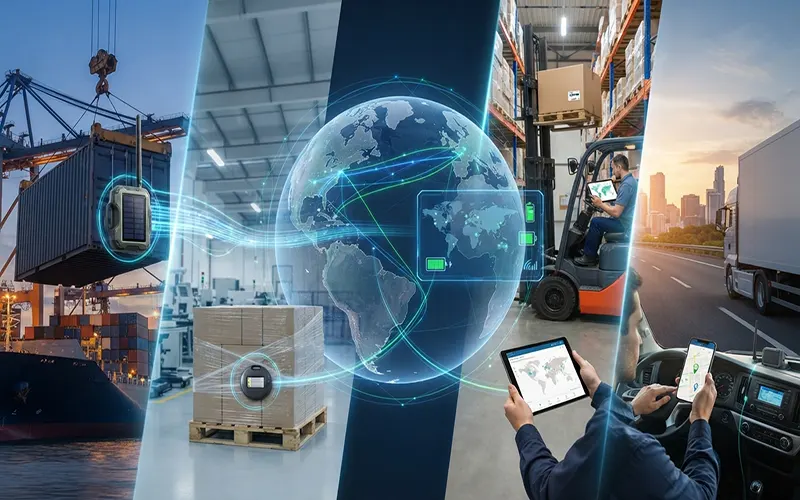
For decades, international supply chains operated with a frustrating blind spot. Once a shipping container left the loading dock, it effectively vanished from visibility until it reached its destination port, leaving logistics managers guessing through customs delays, maritime storms, and transit bottlenecks. Today, that era of uncertainty is fading.
The maturation of Low-Power Wide-Area Network (LPWAN) technologies, ultra-efficient microcontrollers, and advanced battery chemistry has revolutionized logistics. Bulky, power-hungry GPS units have been replaced by smart, multi-year tracker objects. Deploying optimized low-power IoT trackers allows enterprises to achieve granular, real-time visibility across global supply chains without exorbitant cellular data or maintenance overheads.
The Connectivity Backbone: LPWAN Protocols in Logistics
Choosing the right hardware is meaningless without understanding the underlying connectivity network. Global supply chains rely on a diverse mix of LPWAN protocols tailored to different transit environments:
- NB-IoT and LTE-M (Low-Power Cellular): These cellular IoT standards provide global roaming stability, deep indoor penetration, and reliable long-range tracking across international borders. They allow devices to transmit location and sensor data directly to the cloud while consuming a fraction of the power of traditional smartphones.
- LoRaWAN and Private Campus Networks: Utilizing sub-GHz frequencies, LoRaWAN delivers long-range, ultra-low-power connectivity ideal for enclosed industrial distribution hubs, massive freight yards, and maritime container ports where cellular signals struggle to penetrate.
- BLE (Bluetooth Low Energy) Tagging: Secondary BLE beacons affixed to individual boxes or pallets communicate with primary cellular or LoRa gateways. This creates a local mesh network that automates pallet-level tracking and proof-of-delivery milestones without draining primary battery banks.
Hardware Typologies: From Reusable Ruggedized Units to Smart Labels
Modern supply chain hardware is categorized by form factor, durability, and operational use case, adapting to everything from heavy ocean freight to delicate pharmaceutical cargo:
- Rugged Container and Trailer Trackers: These heavy-duty, weather-resistant units are built to endure extreme temperatures, long ocean transits, and physical tampering. Equipped with integrated solar panels, they provide multi-year asset visibility for intermodal containers and over-the-road trailers.
- Pallet-Level and Disposable Smart Labels: The rise of ultra-thin, single-use printed battery labels has made item-level visibility economically viable. These disposable trackers follow individual pallets through complex multi-modal transit legs until final recycling or disposal.
- Multi-Sensor Environmental Loggers: For sensitive cold chains—such as biopharmaceuticals, vaccines, and perishable foods—trackers are embedded with real-time temperature, humidity, shock, and tilt sensors to verify that cargo remained within strict compliance thresholds throughout transit.
Overcoming Deployment and Data Challenges
While low-power IoT hardware has simplified deployment, enterprise engineering teams must still navigate several technical hurdles to maintain system reliability:
- Power Management and Duty Cycling: Maximizing battery life requires intelligent motion-triggered sleep modes and adaptive GPS polling. Devices remain in low-power deep sleep while stationary, waking up to transmit coordinates only when movement, geofence boundary crossings, or environmental anomalies are detected.
- Data Overload and Cloud Integration: Millions of active trackers generate staggering volumes of telemetry. Filtering raw data at the edge and streaming clean, structured location packets into existing ERP, WMS, and supply chain control towers prevents network congestion and dashboard fatigue.
- Global Roaming and Network Fragmentation: International shipping requires navigating shifting carrier agreements and regional frequency variations. Using multi-IMSI and eSIM technologies ensures trackers automatically switch between local carrier networks as cargo crosses international borders.
Low-power IoT trackers transform unpredictable freight networks into intelligent, proactive supply chains. By replacing guesswork with real-time telemetry, organizations can reroute shipments before delays compound, reduce cargo spoilage, and drastically lower inventory buffer requirements.
Ultimately, these connected tracker objects form the foundational infrastructure for the future of autonomous, self-optimizing global logistics—turning physical movement into a seamless, data-driven science.