For decades, factory floors operated under a precarious model: the costly, reactive era of “run-to-failure” or rigid calendar-based maintenance. Equipment was serviced only after it broke down—halting entire production lines—or torn apart on strict schedules regardless of whether parts actually needed replacement. Today, that wasteful paradigm is fading away, replaced by continuous smart monitoring that turns the factory floor into a transparent, communicative ecosystem.
Driven by the explosive growth of Industrial IoT (IIoT) hardware, edge computing, and high-frequency sensors, modern heavy machinery constantly broadcasts its internal health. By capturing real-time physical telemetry and applying machine learning anomaly detection, IIoT sensors allow manufacturers to shift from guessing when machines will break to predicting failures well before they happen.
The Sensor Arsenal: What IIoT Devices Monitor
Modern manufacturing assets endure immense mechanical stress, thermal cycling, and electrical loads. To catch degradation in its infancy, engineers deploy a diverse arsenal of specialized IIoT sensors across the plant floor:
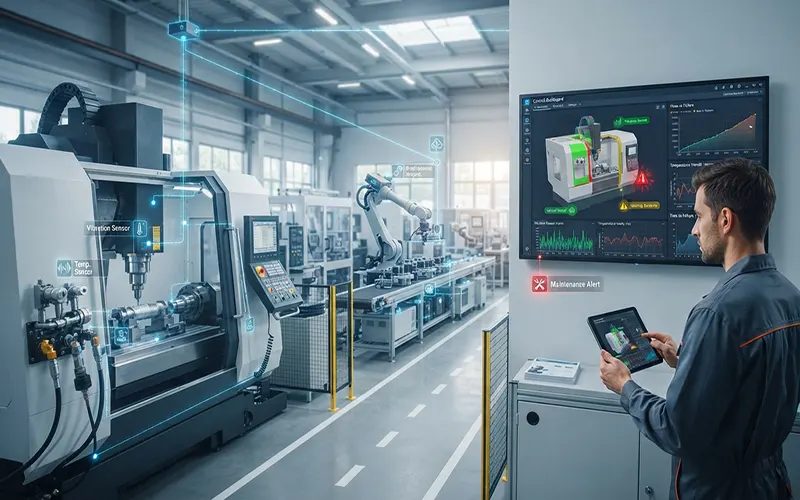
- Vibration and Acoustic Monitoring: High-frequency industrial accelerometers capture microscopic vibrations. By tracking these waveforms, predictive systems can detect early-stage bearing wear, shaft misalignment, and gear imbalance weeks before physical damage occurs.
- Thermal Imaging and Temperature Sensors: Continuous infrared and contact temperature monitoring identify friction hotspots, electrical resistance buildup, and motor overheating, flagging thermal anomalies long before components reach critical failure thresholds.
- Ultrasonic and Pressure Sensors: These devices monitor fluid dynamics, pneumatic leaks, and hydraulic pressure irregularities within automated assembly lines, ensuring fluid systems maintain optimal operating parameters.
- Current and Power Signature Analysis: By tracking electrical draw fluctuations and harmonic distortion in real-time, sensors can spot mechanical binding, rotor degradation, or motor inefficiencies instantaneously.
From Raw Data to Action: The Predictive Analytics Pipeline
Deploying thousands of sensors generates a staggering volume of data. Turning that raw telemetry into actionable maintenance intelligence requires a sophisticated, multi-tiered pipeline:
- Edge Computing vs. Cloud Architecture: Time-critical telemetry—such as an immediate spike in vibration or sudden overheating—is processed locally at the edge using lightweight microcontrollers for instant safety interrupts. Meanwhile, massive historical datasets are streamed to cloud environments for deep trend analysis.
- Machine Learning and Threshold Modeling: Advanced anomaly detection algorithms establish a baseline of “normal operating behavior” for every unique machine. Unlike static thresholds, dynamic machine learning models catch subtle, multi-variable deviations that human operators would easily miss.
- Integrating with CMMS/ERP Systems: Predictive insights are useless if trapped in a dashboard. Modern IIoT pipelines integrate directly with Computerized Maintenance Management Systems (CMMS) and ERP platforms, automatically generating work order tickets and dispatching spare parts the exact moment an anomaly crosses a validated risk threshold.
Overcoming Implementation Hurdles on the Shop Floor
Despite clear return on investment, retrofitting smart sensors into heavy industrial environments presents unique operational challenges that engineering teams must navigate:
- Legacy Equipment Retrofitting: Many plants rely on rugged, decades-old CNC machines and legacy assembly lines that lack digital ports. Startups and engineers overcome this by deploying wireless, non-invasive IIoT sensor pods that attach magnetically and harvest energy or run on long-life batteries.
- Data Overload and False Positives: Flooding maintenance technicians with thousands of unnecessary alerts leads to alarm fatigue. Engineers must calibrate sensitivity thresholds and implement root-cause filtering to ensure teams only respond to genuine, high-probability failure warnings.
- Cybersecurity in Industrial Networks: Connecting critical operational technology (OT) to networks introduces cyber vulnerabilities. Securing industrial data streams requires strict network segmentation, encrypted MQTT protocols, and zero-trust architectures to prevent external tampering.
Industrial IoT-driven predictive maintenance transforms manufacturing from an unpredictable cost center into a lean, resilient, and highly optimized operation. By replacing reactionary chaos with data-backed foresight, plants drastically reduce unplanned downtime, extend asset lifecycles, and slash maintenance budgets.
Ultimately, this represents the foundational stepping stone toward the fully autonomous factory of the future—where robotics, artificial intelligence, and smart sensors converge to create manufacturing lines that heal and optimize themselves in real time.