For decades, traditional enterprises were weighed down by manual data silos, sluggish administrative processing, and relentless operational drag. Employees spent precious hours on repetitive paperwork, while leaders made critical decisions based on lagging historical reports. Today, that rigid operational model is rapidly giving way to agile, intelligent organizations powered by AI automation.
Artificial intelligence has matured from an experimental tech novelty into core enterprise infrastructure across nearly every industry. By strategically embedding AI into daily operations, businesses unlock unprecedented efficiency, elevate data-driven decision-making, and secure sustainable competitive advantages in fast-moving markets.
Core Operational Pillars: Where AI Delivers Maximum Value
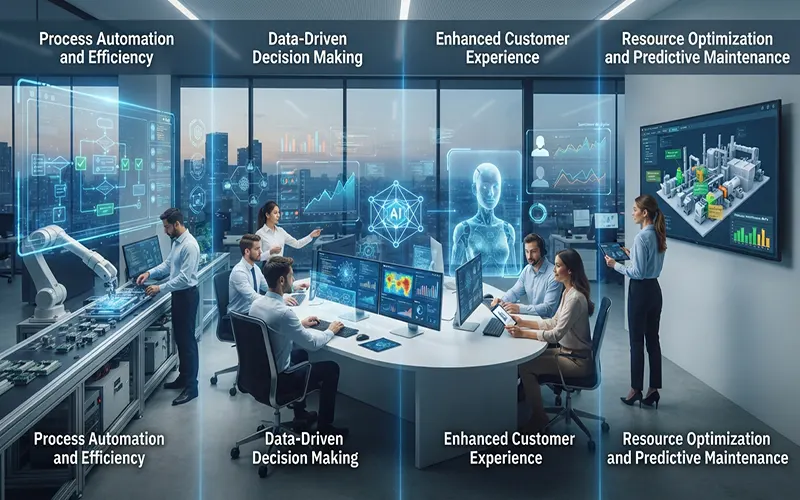
Implementing artificial intelligence successfully requires identifying where it creates the greatest operational leverage. Rather than treating AI as a scattered collection of tools, modern enterprises integrate it across four foundational pillars:
- Process Automation and Efficiency: Intelligent automation streamlines routine administrative tasks, manual data entry, invoice processing, and document routing. By taking over repetitive clerical duties, AI frees human teams to focus on creative problem-solving and high-level strategy.
- Data-Driven Decision Making: Enterprises sit on mountains of operational data. Machine learning models and predictive analytics turn this raw data into actionable foresight, helping leaders forecast market trends, optimize supply chains, and eliminate operational guesswork.
- Enhanced Customer Experience and Personalization: Customer expectations demand instant engagement. AI-powered systems elevate service quality through intelligent support triage, predictive routing, and dynamic personalization that adapts in real time to user behavior.
- Risk Management and Fraud Detection: Modern threats move too fast for manual audits. Real-time anomaly detection algorithms continuously monitor enterprise networks and transaction streams, flagging compliance breaches, cyber threats, and financial discrepancies instantly.
Measuring the Return on Investment (ROI): Beyond Cost Reduction
While cutting operational costs is an attractive initial benefit, the true ROI of artificial intelligence extends far deeper into the core mechanics of business growth:
- Speed to Market: Automated workflows and generative systems accelerate product development cycles, content production, and go-to-market strategies, allowing companies to outpace slower competitors.
- Resource Optimization and Capital Reallocation: AI shifts human capital away from mundane execution. Employees redeployed from administrative burdens can direct their energy toward high-value innovation, customer relationships, and revenue-generating initiatives.
- Scalability Without Linear Headcount Growth: AI-augmented infrastructure decouples revenue growth from administrative scaling. Businesses can handle massive surges in customer volume, data processing, and transaction output without requiring a proportional increase in administrative staff.
Navigating Adoption Challenges for Sustainable Success
Despite extraordinary operational benefits, rushing into AI integration without careful planning can lead to friction. Enterprise leaders must navigate several critical adoption challenges:
- Cultural Readiness and Change Management: Technology adoption often triggers internal resistance. Successful organizations combat this by framing AI as a collaborative digital coworker that augments human capability rather than a replacement tool.
- Data Integrity and Governance: Garbage in means garbage out. Clean, well-structured, and secure enterprise data is the absolute prerequisite for effective operational AI models.
- Security and Compliance Standards: Safeguarding proprietary business intelligence, customer data, and intellectual property requires strict security protocols, encrypted pipelines, and unwavering adherence to regulatory compliance standards.
Artificial intelligence transforms business operations from reactive firefighting into proactive, resilient orchestration. By replacing manual bottlenecks with intelligent automation, organizations drastically reduce overhead, accelerate execution speed, and position themselves for long-term market dominance.
Ultimately, operational AI is no longer an exclusive luxury for tech giants and industry titans. It has become an essential survival baseline for any modern enterprise striving to thrive in an increasingly complex and automated global economy.